
The Power of High Jump to Unlock Futures
Over the past 35 years, thousands of deserving students have brought the very best of themselves to our program and put themselves on the path to thrive in high school and beyond. High Jump cultivates courage and curiosity by empowering students at a pivotal time, building their confidence, and supporting them in navigating the sticky transition from childhood to adolescence.
As of today, over 3,000 students have gone through our program. 100% of them graduate from high school, 87% complete college, and 78% are the first in their families to attend college. That achievement breaks cycles of poverty and creates a real economic impact for themselves, their families, and their communities.
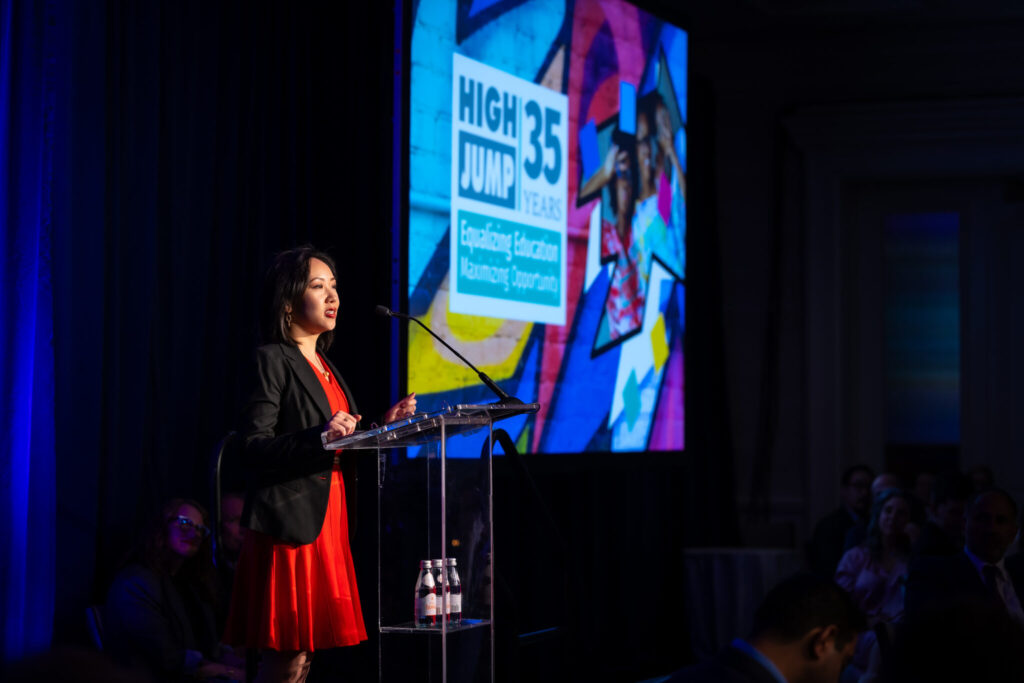
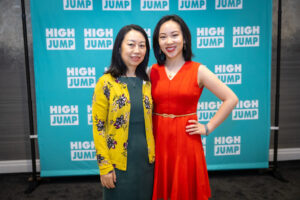
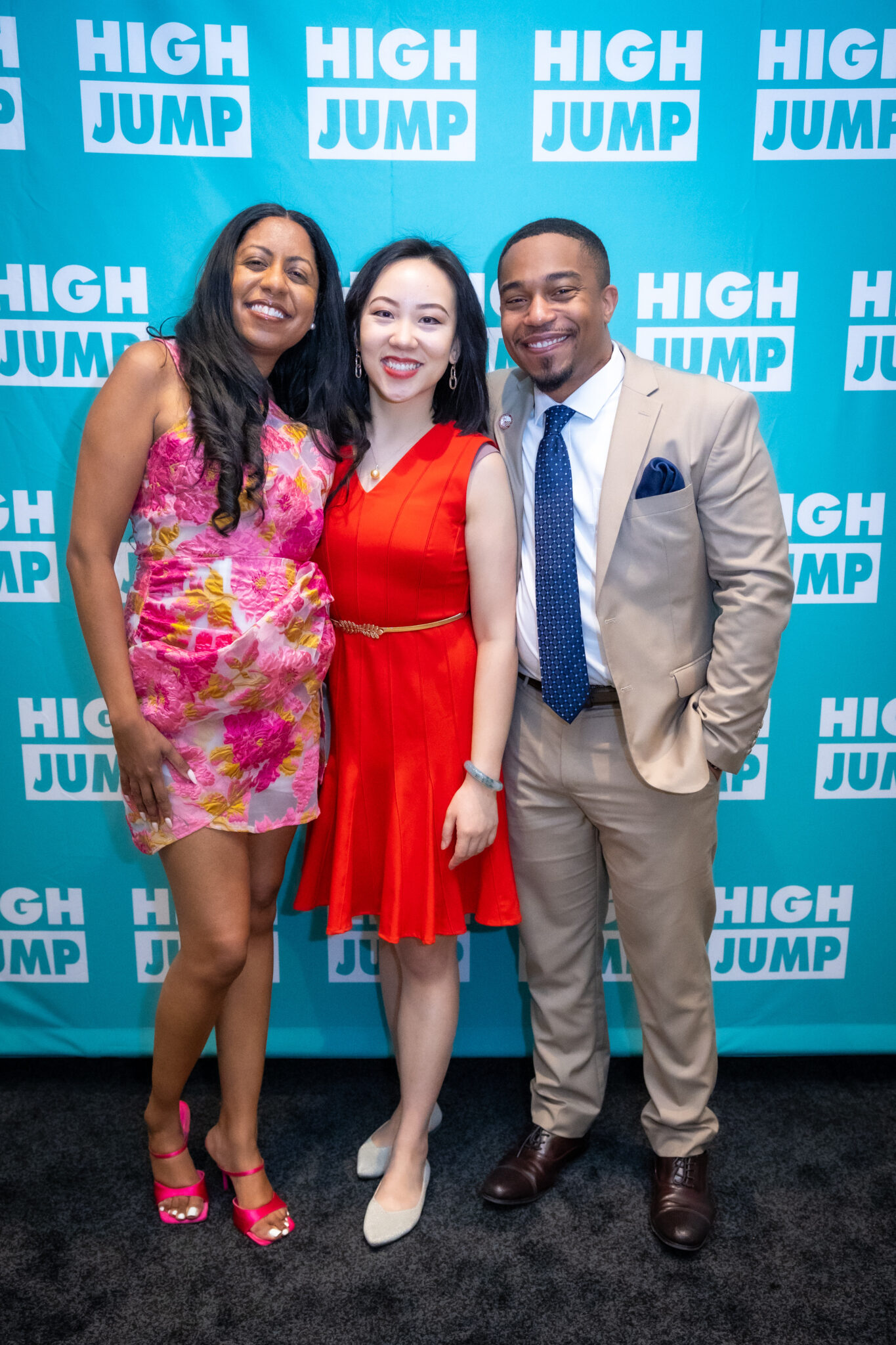
High Jump alumna, Gina Chen (Cohort 13), spoke at High Jump’s Annual Spring of Opportunity Benefit on May 2, 2025.
Read on for Gina’s engaging story about her High Jump journey.
Good evening. It is an incredible honor to be here with you tonight. My name is Gina Yunru Chen, and I am a proud alumna of High Jump Cohort 13. I am also a first-generation immigrant and the first in my family to attend college—now a lawyer, entrepreneur, and even more proudly, a board member of this very program that helped shape who I am.
I still remember the night before my first day of school in America. I was 9 years old. I sat with a dictionary, searching for an English name with my mother, who is here in the room with us tonight. The school superintendent had said my Chinese name was too hard to pronounce. We landed on “Gina”—short, simple, and easy to remember. I wrote it on my palm in black marker, along with the letters for “girls bathroom.” That was my survival toolkit.
In those early months, I discovered two great American traditions: one, far more delicious than the other.
First—glazed donuts. I treated myself to two every morning from Dominick’s. (May it rest in peace.) Then came the second, more mystifying tradition. For three straight school days, I stood outside locked doors, convinced classes were cancelled. Why? (Any guesses?) Not a snowstorm, not a strike. Turns out, I had stumbled into daylight savings time. Welcome to America.
But even amid all the confusion, something unexpected happened. My grades in English and social studies went from F’s to A’s. I became known as a “model student.” I started chasing extra credit like it was a competitive sport. Then one day in sixth grade, a man came into our homeroom and told us about a program called High Jump. He said it was for students who wanted to spend their summers doing “fun” things like learning quantum physics and writing essays about global trade ethics. I was sold.
At High Jump, I found my people—other kids who didn’t mind being called teacher’s pet, who color-coded their binders, carried multiple pens just in case, who were just as insufferable as I was in chasing after extra credit work, and who genuinely got excited about a pop quiz. It was both thrilling and humbling.
I vividly remember my Issues and Ideas class—reading Naomi Klein’s book and being asked to form an opinion about consumer culture. My face flushed red the first time I was asked what I thought, not just what I could memorize. I wasn’t used to that. I knew how to memorize facts, historical figures, and key agricultural imports and exports of Argentina. But this? This required me to trust my voice.
And something beautiful happened—I started to find that voice. My High Jump teachers believed in my ability to think critically, to lead. Slowly, I started to believe it too. They also saw other sides of me. They celebrated my love of visual arts. They asked me about the meaning of my Chinese name. For the first time, I wasn’t just “Gina.” I was Yunru. I was both.
High Jump didn’t just prepare me academically. It made me feel fully seen. It helped me embrace the multidimensional me. It gave me the confidence to own my voice, to own my story. That foundation stayed with me through high school at Francis W. Parker, where I explored literature and history, especially the stories of Asian Americans and immigrants. That confidence inspired me to actively connect with the Chinese diaspora community and other immigrant communities in Chicago. That confidence and embrace of my multidimensionality carried me to Yale, where I studied political science and the history of collective action. It carried me across oceans as a Fulbright scholar, researching post-earthquake rebuilding in rural China. It carried me through founding a nonprofit, Education In Sight, which to this day has delivered free eye care to thousands of students in over 300 rural schools. It took me back to my ancestral home, the same place where I spent summers as a child catching grasshoppers and chasing dragonflies with bamboo poles dipped in spider webs. (Yes, that was a thing.) I went on to help launch one of Southwest China’s first organic farms. We built a co-op that not only improved livelihoods but preserved critical water systems in the countryside. I even found myself negotiating land-use rights with local authorities and developers—learning quickly that you can plant rice all day, but if the wrong official shows up, nobody eats rice.
So what do you think I did next? Let me ask you this: if you were working with grassroots NGOs on water preservation and climate justice, what would you do next? Stay in the NGO world? A master’s in public policy?
Nope – I went to Northwestern Law School. Yes. I told you—unexpected. And after law school—surely I’d go back to nonprofit work, right?
Nope. I went to Wall Street. I joined one of the world’s top law firms, working on multi-billion-dollar mergers and acquisitions.
Why? Because I knew I needed to understand business. I needed to gain tools I didn’t have, so I could one day bridge the worlds I cared about the most: community and capital.
On paper, I was “making it.” But in my heart, I felt disconnected. I wasn’t practicing law the way I wanted. I wasn’t connected to clients or their impact. I started to feel one-dimensional. In those halls of power, I often felt like I had to compress parts of myself, and tuck away the parts of me that had once made me whole. The artist. The immigrant. The advocate.
When my firm said, “You’re on track for partner,” I paused. I asked myself: what would I tell that 9-year-old girl with a black marker in her hand? The girl who hadn’t yet become “Gina.” The girl who still proudly answered to Yunru. Would she be proud?
The answer was clear. I needed to do law differently. So I left Big Law and started One Ally, a boutique law firm with Wall Street rigor and a grassroots heart. I get to support ambitious, mission-driven founders—especially women and minority entrepreneurs—who are transforming their industries and redefining what it means to lead. I get to bring all of me to my work—lawyer, strategist, artist, immigrant, donut lover. And that multidimensionality? That spark? It started here. At High Jump.
High Jump challenged me to think, not just memorize, to speak, not just listen, to be fully myself and to see others fully, too. That is the power of this program, and tonight, that power is desperately needed.
Tonight, we are surrounded by people who believe that a student’s zip code should never define their future, that brilliance lives in every neighborhood, and that a kid with a black marker in her hand deserves to write her own story.
When you give to High Jump tonight, you are not just funding a summer program. You are investing in the unexpected. You are unlocking a future that no one, except that child and you, might have imagined. You are opening the door for the next child who dares to imagine more, who wants to build, lead, and give back, and who might one day start a business, run for office, or give a speech at a gala like this.
So I invite you to be bold. Let’s raise tides. Let’s make waves. Let’s lift every boat in this room and beyond. Thank you so much!